First Impressions in the Digital Age: Why Your Website Is Your Handshake
Visitors judge a business in seconds. Here is what a website has to do in that moment, and why dynamic tools turn a good first impression into a customer.
People form opinions fast. Psychologists have found that we judge a stranger’s trustworthiness, competence, and likability within moments of meeting them. We make that call before a word of the conversation has registered, and it is hard to undo. Once someone decides you look professional, or sloppy, they spend the rest of the interaction looking for evidence that confirms it. This is why first impressions matter so much. They set the frame for everything that follows.
For a long time a business made its first impression in person. It might be a storefront, a sign, a handshake, or a friendly voice on the phone. For most businesses that has changed. Today a customer’s first contact usually happens on a screen, often late at night, often on a phone, and often while comparing three or four competitors in adjacent tabs. A plumber, a remodeler, a massage therapist, or a realtor may be the best at their craft in town. A potential customer will not know that until they’ve made some decision about the business based on what they see online. The website has become the new front door, the new storefront, and the new handshake.
What a Visitor Decides in Seconds
A visitor landing on a business website is answering a few quiet questions. Is this a real, established company? Can I trust them with my home, my money, my health? Do they understand what I need? How hard will it be to get help?
Design answers most of these before the visitor reads anything. A clean layout, consistent branding, sharp photography, readable typography, and a fast, mobile-friendly experience all signal care. A cluttered, outdated, or broken site signals the opposite. Visitors extend that impression to the business itself. If the site looks neglected, they assume the work will be too. If it looks polished and thoughtful, they assume the same of the service. Fair or not, a website is read as a preview of how the business operates.
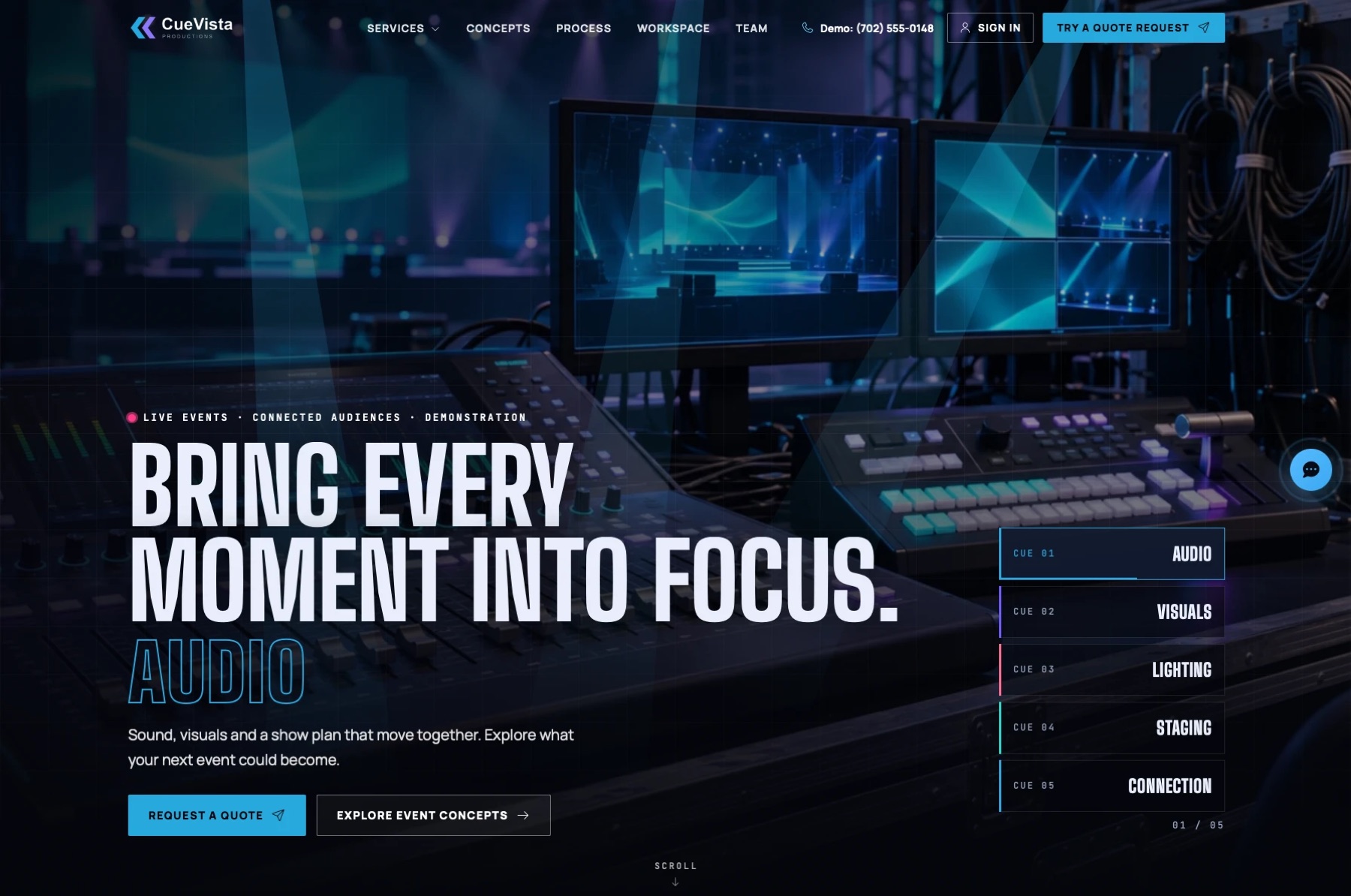
Here is what that looks like in practice. Cue Vista Productions is a video production company, and its site has to show the quality of the work before anyone asks for a quote. The preview below is live, so scroll inside it.
Looking Good Is the Start, Not the Finish
A beautiful site that does nothing is a brochure. Brochures are fine, but visitors now expect more. They expect to act: to ask a question, get a price, or reserve a time without picking up the phone or waiting until Monday morning. The sites that make the strongest impression are dynamic and useful, and they are built on modern cloud and AI capabilities.
Estimate requests. For service businesses, the first thing most visitors want is a price. A clear, simple estimate form lets them describe their project in a minute and get on the contractor’s radar at once. It turns curiosity into a lead and shows that the business is organized and wants the work.
Appointment booking. Every extra step between “I’m interested” and “it’s scheduled” costs customers. Online booking removes that friction. A visitor can pick a time that suits them at 10 p.m. on a Sunday, and the business wakes up to a confirmed appointment instead of a voicemail. It also tells the customer that this company respects their time.
Blogs and fresh content. A blog shows a business is active and knowledgeable. Helpful articles answer the questions customers are already asking, from how long a tint lasts to what to look for in a water softener. They build trust before the first conversation, and they help the business show up in search results. A site with current content looks alive. A site whose last update was years ago looks abandoned.
Live chat. Some visitors don’t want to fill out a form or make a call. They want a quick answer to a quick question. Live chat meets them in the moment, when interest is highest. Responding quickly is one of the most persuasive things a business can do, because it shows the customer will be looked after.
An AI concierge. This feature may do the most to change what a first impression feels like. An AI concierge can greet visitors, answer questions about services and service areas, explain how the process works, collect project details, and guide people to an estimate or a booking, at any hour and without getting tired. For a small business that can’t staff a front desk around the clock, it is a tireless receptionist that never forgets to follow up. Visitors don’t have to hunt through menus. They just ask. A site that talks back, understands the question, and helps right away feels modern and attentive. It tells the visitor that the business is competent, current, and ready for them.
Why It All Adds Up
The best websites combine these elements into a single experience: a look that earns trust, and tools that turn that trust into action. A visitor arrives, sees a professional brand, asks the concierge a question, requests an estimate, books a visit, and leaves with a confirmation. At no point did they wait, or wonder whether anyone was there. That experience says more about the business than any slogan could.
The cloud makes this practical for small businesses. Capabilities that once required a large IT department can now be delivered as part of a well-built platform, with scheduling, messaging, content, and AI working together. A local contractor or clinic can now offer an online experience that rivals much larger competitors. That levels the playing field, because the first impression is judged on quality and not on company size.
The Cost of Getting It Wrong
The opposite is just as true. A slow, dated, or confusing website is a first impression the business never gets to correct. The visitor doesn’t leave a complaint. They quietly close the tab and call the next company on the list. Most businesses never see these lost customers, which is why the cost is easy to miss. It is real all the same. Every visitor who leaves unimpressed is a job that went to someone else.
Conclusion
First impressions are quick, lasting, and often decisive. For a growing number of businesses, the website makes that impression before any person does. A well-designed, good-looking, dynamic site tells customers they’re in capable hands. Add estimate requests, online booking, a living blog, live chat, and an AI concierge, and the site becomes more than a first impression. It becomes the first step of the customer relationship, one that works around the clock. In a market where the first impression is so often digital, a business’s website is the most important handshake it will ever give.